
MetaClarity
Turning a Complex Metadata Platform into an Intelligent Enterprise Experience
Industry: Enterprise SaaS | Data Governance
Service: Enterprise UX | Product Strategy | UI/UX Design | Design Systems | AI-Ready Experiences
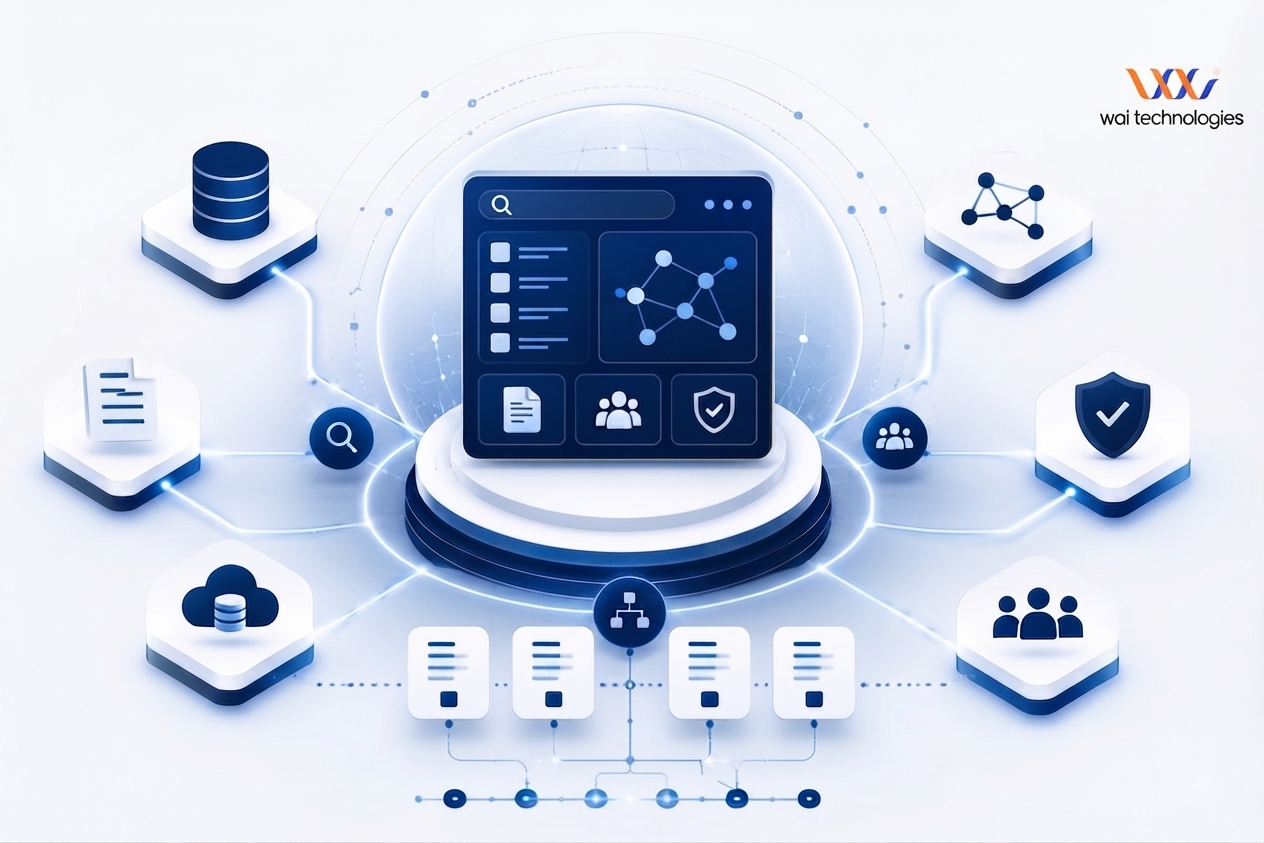
MetaClarity was designed to centralize metadata discovery, governance, lineage, documentation, and collaboration. Wai Technologies reimagined it as a unified enterprise metadata intelligence platform, combining user-centred design, Design Thinking, enterprise UX, and a scalable design system.
The Challenge:
Managing enterprise metadata shouldn't require users to navigate through fragmented systems, complex workflows, and disconnected information. MetaClarity was designed to centralize metadata discovery, governance, lineage, documentation, and collaboration. But the existing experience made these tasks harder than they needed to be.
Users faced several critical challenges:
Difficult Navigation
- Complex navigation made everyday metadata tasks harder than they needed to be.
Fragmented Metadata
- Disconnected information across systems limited visibility and control.
Manual Documentation
- Documentation relied on manual effort, slowing discovery and collaboration.
Limited Lineage Visibility
- Users lacked clear visibility into data relationships and ownership.
Inconsistent Interfaces
- Inconsistent UI patterns across modules increased cognitive load.
Disconnected Governance Workflows
- Governance workflows were fragmented and hard to scale for future AI capabilities.
How Wai Solved It:
Wai Technologies reimagined MetaClarity as a unified enterprise metadata intelligence platform, combining user-centred design, Design Thinking, enterprise UX, and a scalable design system.
Discovery & Design Thinking
- Conducted UX audits across 9 enterprise modules.
- Facilitated stakeholder workshops and Design Thinking sessions.
- Prioritized high-impact workflows for redesign.
Connected Workspace
- Brought metadata, governance, lineage, analytics, ingestion, and documentation into a more connected experience.
- Created reusable components for consistent product experiences.
AI-Assisted Capabilities
- Contextual assistance integrated into primary workflows.
- Intelligent search and metadata recommendations.
- AI-powered documentation without taking users away from their work.
Impact at a Glance:
- 9+ Enterprise Modules: Standardized UX patterns across a complex enterprise platform.
- 100K+ Metadata Assets: Experience designed to support large-scale metadata discovery and management.
- 60% Faster Metadata Discovery: Improved navigation, search, information architecture, and contextual access.
- 24/7 AI-Powered Assistant: Context-aware assistance integrated directly into enterprise workflows.
- Production-Ready Design: Detailed interaction specifications, reusable components, responsive behaviours, and edge-case documentation prepared for engineering implementation.
What Changed:
From Fragmented to Connected
- Metadata, governance, lineage, documentation, and ownership information were brought together into connected workflows.
From Complex to Discoverable
- Improved information architecture, global search, contextual metadata, filtering, and scalable tables made enterprise data easier to find and understand.
From Static to Interactive
- Dashboards, analytics, lineage, and asset management were redesigned around interactive exploration rather than static information.
From Generic AI to Contextual AI
- The AI assistant evolved from a floating chatbot into a persistent workspace with conversation history, file attachments, guided prompts, follow-up questions, and contextual assistance.
From Inconsistent to Unified
- A reusable design system standardized components, interaction patterns, typography, spacing, and visual language across the platform.
Key Benefits
- Improved metadata discovery and navigation
- Simplified governance and data management workflows
- Better visibility into data lineage and relationships
- Consistent UX across 9+ enterprise modules
- Reduced product complexity through a unified design system
- Improved platform usability, maintainability, and scalability
- AI-ready foundation for future intelligent capabilities
- Production-ready designs that reduced implementation ambiguity
- Stronger collaboration between product, UX, business, and engineering teams
The redesigned Asset, Lineage, Glossary, Domain, Ingestion, Analytics, and AI Assistant experiences were specifically designed to reduce navigation effort, improve information visibility, and make complex enterprise workflows easier to manage.
How Wai Approaches Enterprise Product Transformation:
- Enterprise Discovery: Understand workflows, stakeholders, data ecosystems, and operational challenges.
- Product Strategy: Align business goals, governance requirements, and technical constraints.
- Enterprise UX: Simplify complex workflows and create intuitive user journeys.
- Design Systems: Establish reusable components and consistent interaction patterns.
- Engineering Collaboration: Deliver production-ready designs with clear specifications and edge cases.
- AI-Ready Experiences: Design intelligent workflows around contextual assistance, recommendations, and AI-powered search.
Why It Matters:
Enterprise platforms often become harder to use as the number of workflows, users, data sources, and governance requirements grows. Good enterprise UX doesn't just make a product look better. It makes complex work easier to understand, faster to complete, and easier to scale.
For MetaClarity, the transformation created a consistent product experience while establishing a foundation for continued analytics, governance, and AI innovation.